
Levi’s x Christelle Kocher
Début juillet, dix silhouettes ont fait entrer le 501® dans le calendrier de la Semaine de la Haute Couture parisienne. Une première pour la marque américaine, et un pari clair sur ce que pèse aujourd’hui une matière de masse dans le vocabulaire du sur-mesure.
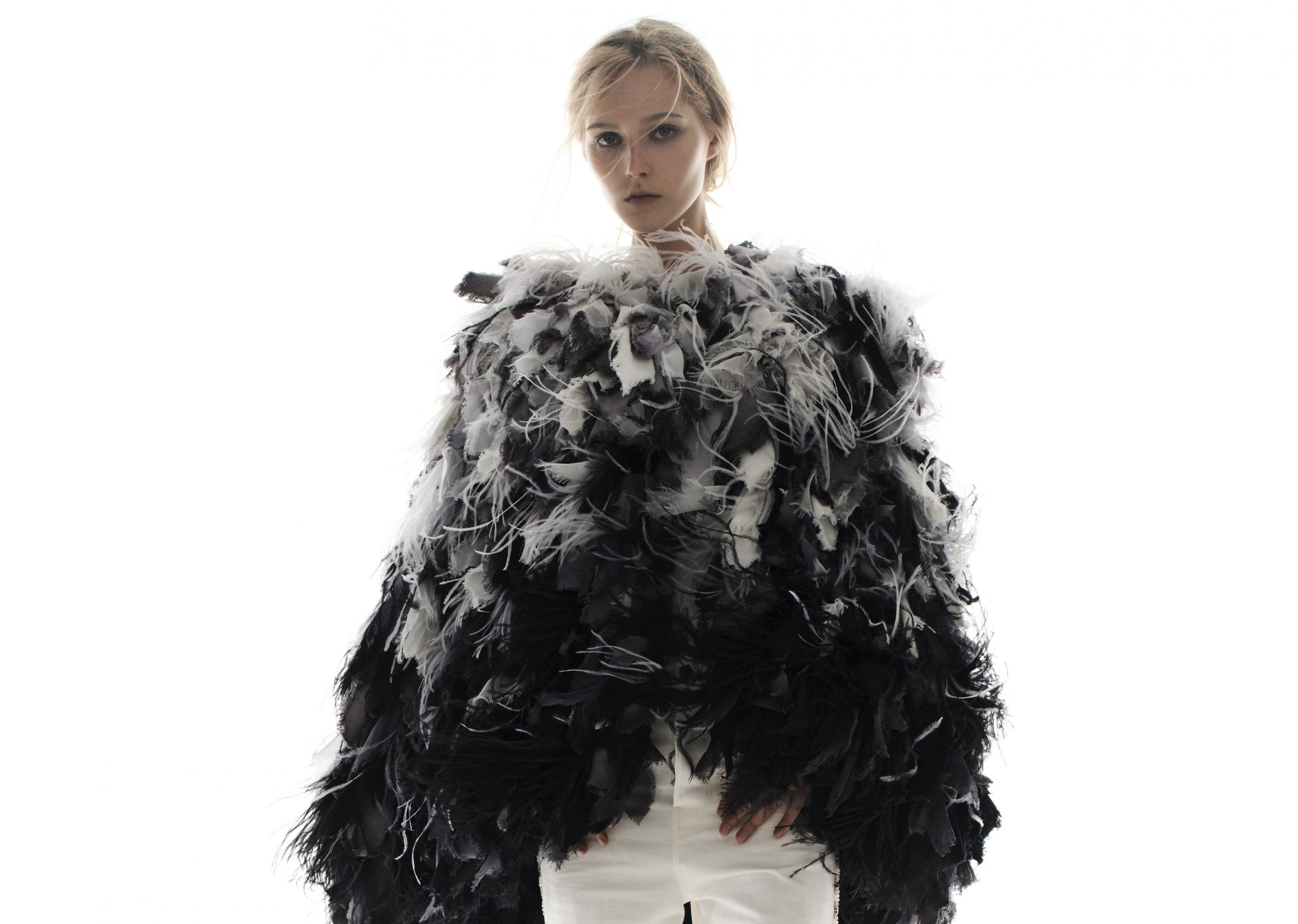
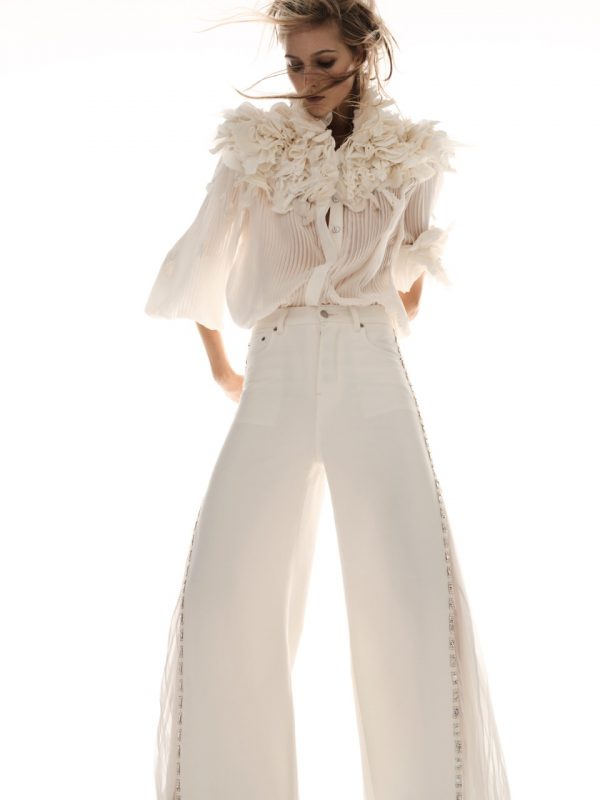
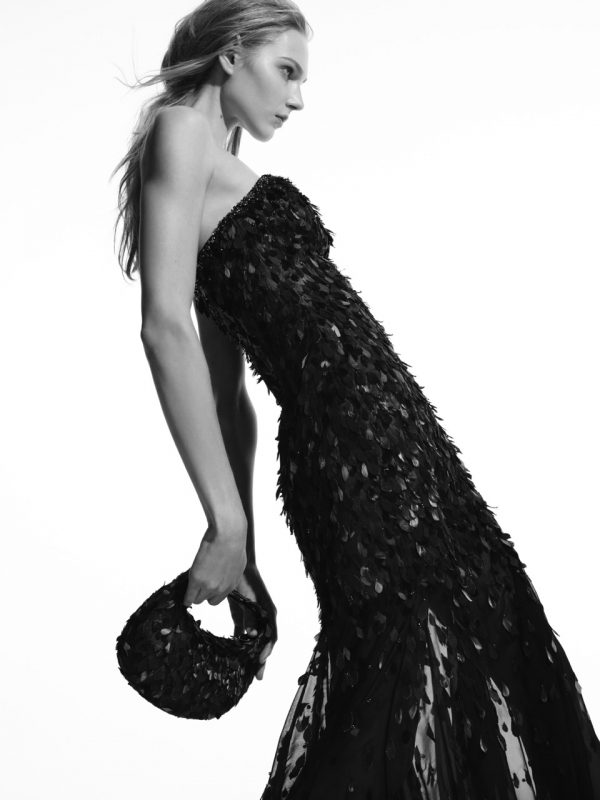
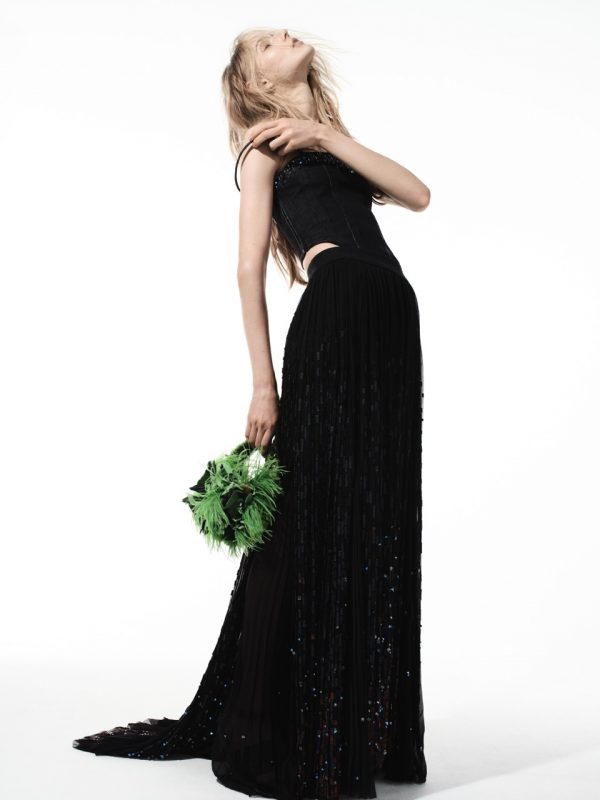
Toute la collection tient dans une règle de départ : la toile denim fournit la structure des dix pièces, du corps de la robe jusqu’aux volumes les plus travaillés. Le reste vient s’y greffer par accumulation de gestes. Le pli, monté en strates, referme des bustiers dont le dessin évoque des corolles ; la plume gagne les capes en dégradés qui prolongent le mouvement du corps ; la dentelle se pose en surface ; la résine fige des morceaux de toile jusqu’à leur donner un éclat minéral ; le cuir revient en broderie. À la sortie, la veste Trucker et le jean cinq poches servent moins de référence que de matière brute à réécrire. L’exercice produit ses meilleurs moments quand la toile change franchement d’état. Une robe entièrement montée en plumes, doublée d’une cape assortie, superpose les épaisseurs jusqu’à obtenir un effet d’écailles qui capte la lumière par fragments. Le vestiaire du soir suit la même logique : le débardeur et la chemise, rehaussés de broderies couture, quittent le registre utilitaire pour celui de la pièce habillée. Les accessoires closent la démonstration avec un sac Baby Brooklyn revu pour l’occasion et des coiffes en plumes pensées pour amplifier la silhouette et le mouvement.
In early July, ten looks brought the 501® into the schedule of Paris Haute Couture Week. A first for the American label, and a clear wager on what a mass-market cloth is worth today in the vocabulary of made-to-measure.
The whole collection rests on a single opening rule: denim supplies the structure of all ten pieces, from the body of a dress to the most worked volumes. Everything else is grafted on by an accumulation of gestures. Pleating, built up in strata, closes bustiers whose drawing suggests corollas; feathers move across capes in gradations that extend the movement of the body; lace is laid over the surface; resin sets fragments of canvas until they take on a mineral sheen; leather returns as embroidery. By the end, the Trucker jacket and the five-pocket jean function less as references than as raw material to be rewritten. The exercise finds its best moments when the canvas changes state outright. A dress built entirely from feathers, lined with a matching cape, layers thickness upon thickness until it yields a scaled effect that catches the light in fragments. The evening wardrobe follows the same logic: the tank and the shirt, lifted by couture embroidery, leave the utilitarian register for that of the dressed piece. Accessories close the demonstration with a Baby Brooklyn bag reworked for the occasion and feathered headpieces conceived to amplify silhouette and movement.
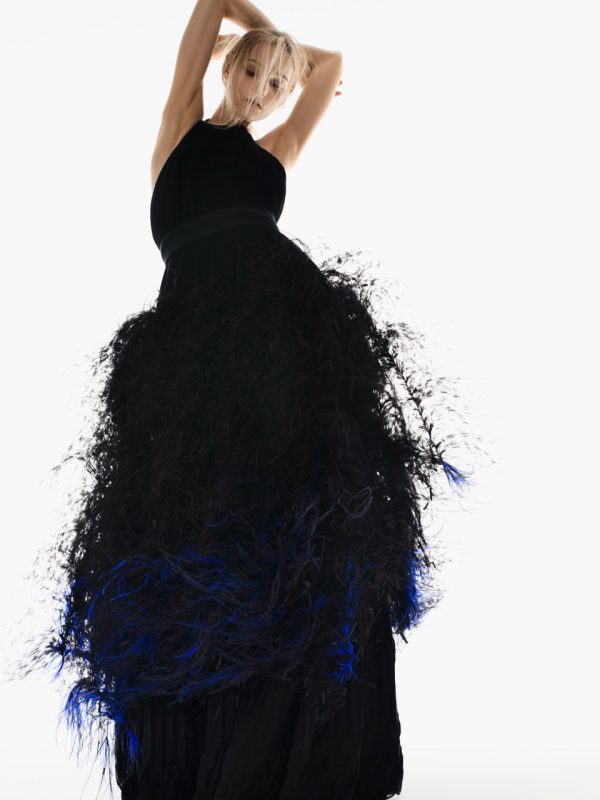
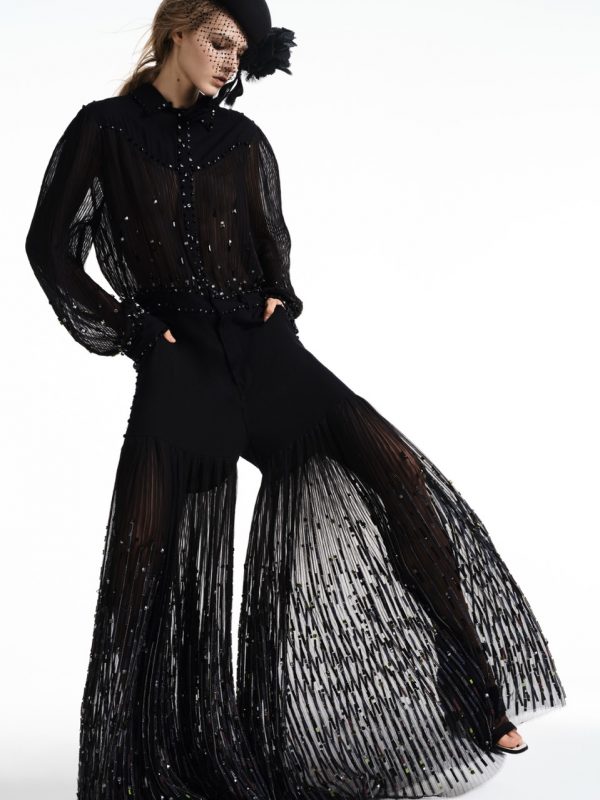
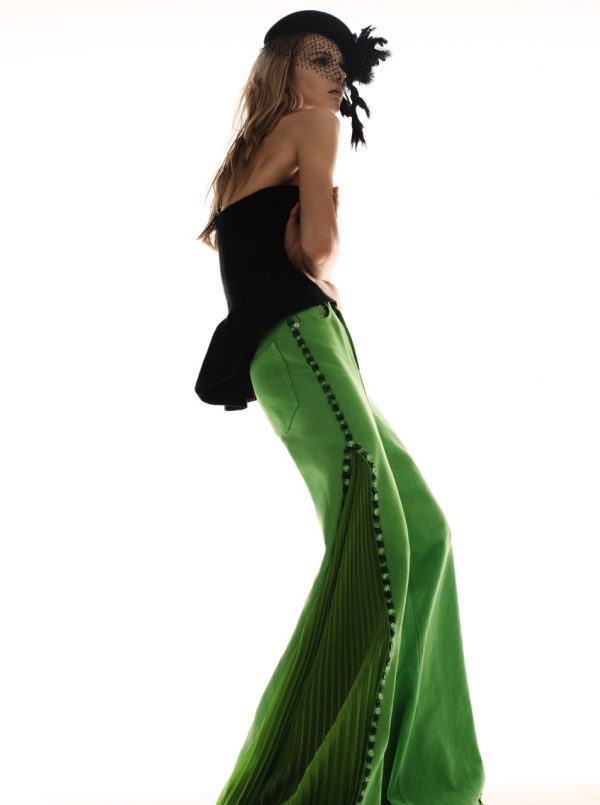
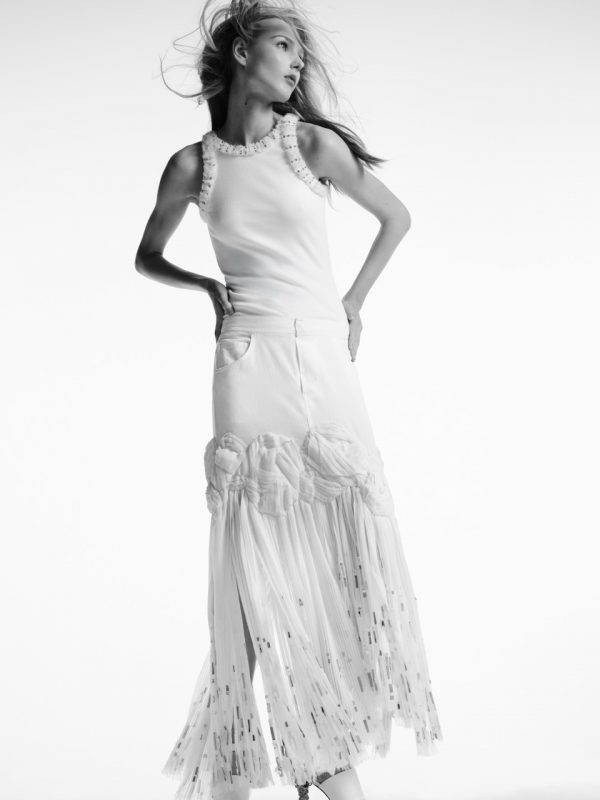
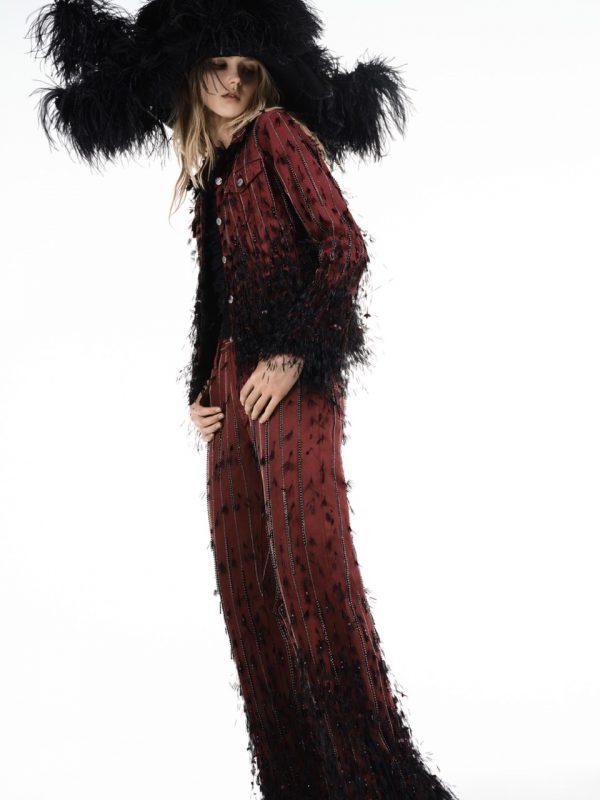
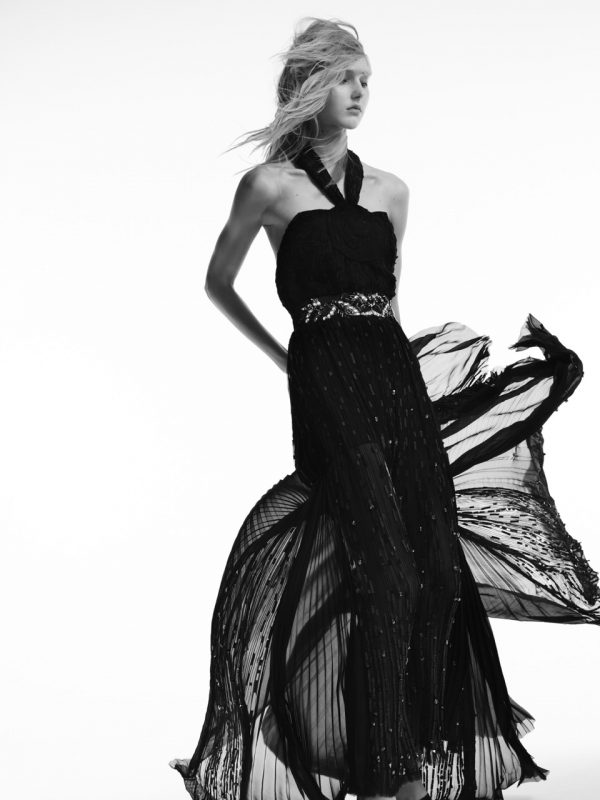
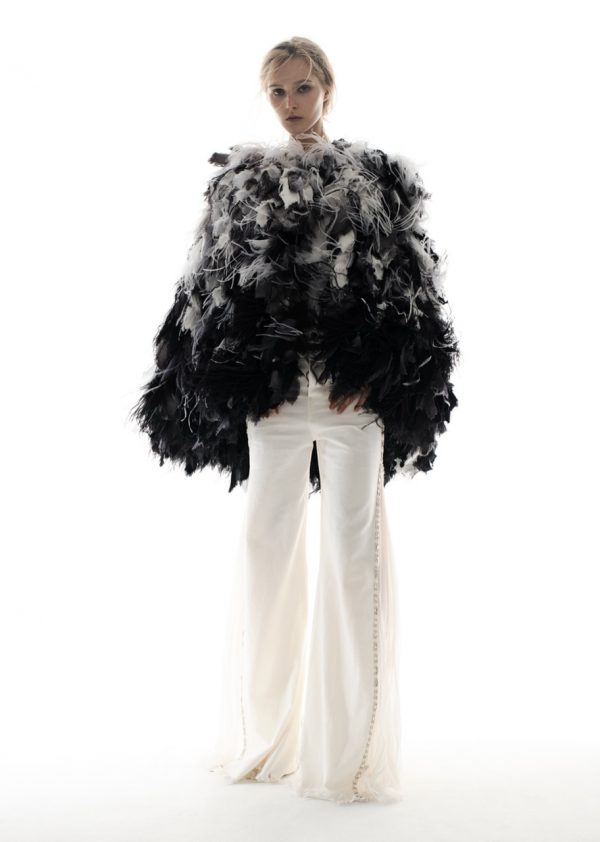
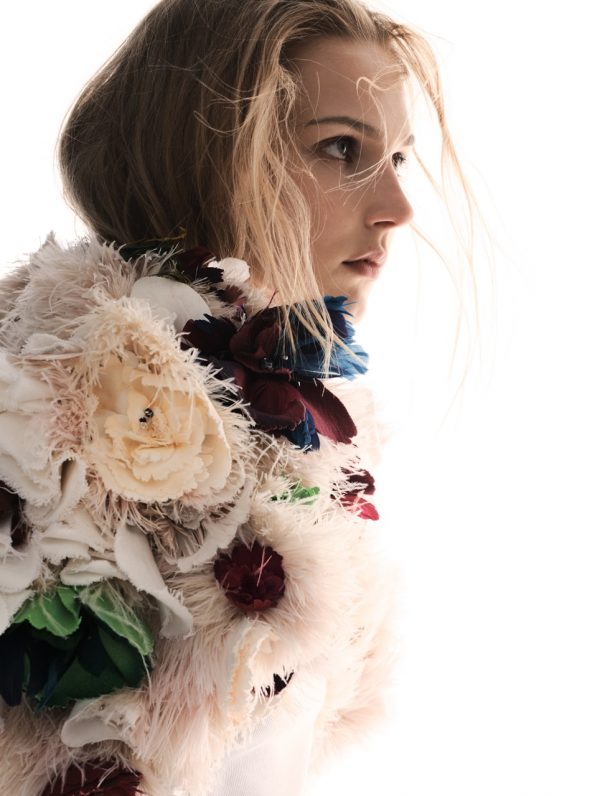
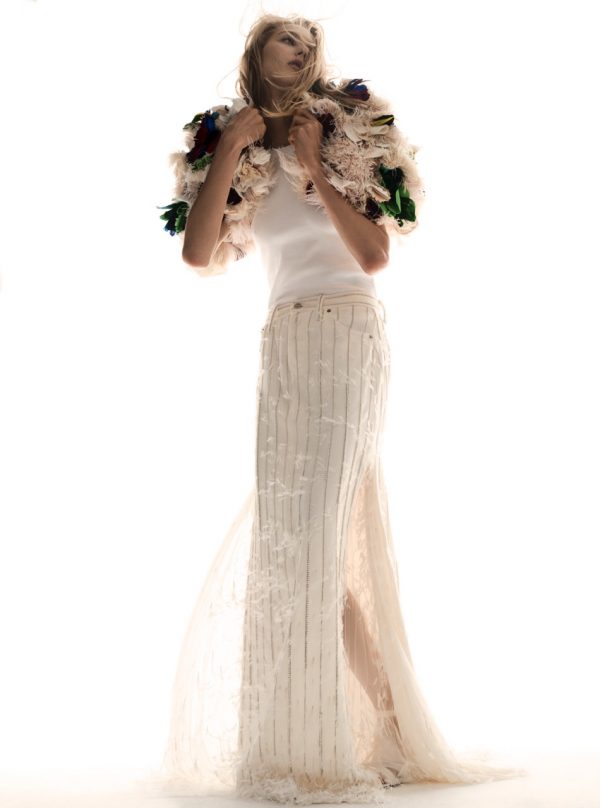
Le nom de Christelle Kocher éclaire la cohérence de l’ensemble. Depuis 2010, elle dirige artistiquement la Maison Lemarié, l’un des Métiers d’art de Chanel, dont la spécialité couvre exactement le terrain de la capsule : la plume, la fleur, la broderie, l’innovation textile. La marque américaine a donc choisi une praticienne, avec l’atelier qui va avec. Le parcours confirme l’orientation. Formée à Central Saint Martins, Kocher a travaillé chez Bottega Veneta, Dries Van Noten, Chloé, Martine Sitbon et Giorgio Armani avant de fonder Koché en 2016, une maison qui installe les codes de la couture dans un usage quotidien et qui lui vaut le Grand Prix de l’ANDAM en 2019. Sa formule, « Couture-à-Porter », résume la ligne qu’elle tient depuis dix ans. Partagée entre Paris et New York, elle décrit ce projet comme le point de rencontre de ses deux géographies de travail, et l’occasion de réunir deux équipes autour d’une même matière.
La partie technique dépasse le geste d’atelier. Plusieurs teintures exclusives ont été mises au point à l’Eureka Lab, le centre de recherche de Levi’s® à San Francisco, et l’ensemble des traitements a été développé pour ce projet précis. La campagne signée Kayla Connors tient d’ailleurs une ligne cinématographique et intimiste à la fois, attentive aux matières et aux constructions, qui documente la fabrication autant qu’elle vend l’image. Reste l’objectif industriel, que la marque énonce ouvertement. Mathilde Vaucheret, vice-présidente marketing Europe, situe l’opération dans une stratégie d’implantation culturelle sur le continent, avec une cible explicite : la scène, le tapis rouge, les grands rendez-vous où se fabrique la désirabilité. L’ambition se comprend à l’échelle du groupe, qui a annoncé 6,3 milliards de dollars de chiffre d’affaires net pour l’exercice 2025 et distribue ses produits dans environ 120 pays. Sur un marché où des concurrents vendent plus cher une toile techniquement voisine, la différence se joue sur le capital symbolique. Se soumettre au calendrier couture, avec une créatrice dont la légitimité artisanale se vérifie à l’atelier, revient à en acquérir directement.
La suite se lira ailleurs que sur les images de campagne. Le vrai indicateur tient à ce que la capsule laisse derrière elle : des teintures qui migrent vers les collections courantes, des finitions qui redescendent dans la ligne permanente, une coupe de 501® redessinée par ce détour parisien. À ce compte, dix silhouettes de juillet valent largement l’investissement.
Christelle Kocher’s name accounts for the coherence of the whole. Since 2010 she has been artistic director of Maison Lemarié, one of Chanel’s Métiers d’art, whose specialisms map exactly onto the terrain of the capsule: feather, flower, embroidery, textile innovation. The American label has chosen a practitioner, then, and the atelier that comes with her. The trajectory confirms the direction. Trained at Central Saint Martins, Kocher worked at Bottega Veneta, Dries Van Noten, Chloé, Martine Sitbon and Giorgio Armani before founding Koché in 2016, a house that installs the codes of couture inside everyday use and that won her the ANDAM Grand Prix in 2019. Her formula, « Couture-à-Porter », sums up the line she has held for a decade. Divided between Paris and New York, she describes the project as the meeting point of her two working geographies, and an occasion to gather two teams around a single material.
The technical dimension reaches beyond the gesture of the atelier. Several exclusive dyes were developed at Eureka Lab, Levi’s® research centre in San Francisco, and the full set of treatments was created for this project specifically. The campaign by Kayla Connors holds a register at once cinematic and intimate, attentive to materials and construction, documenting the making as much as it sells the image. Then there is the industrial objective, which the brand states openly. Mathilde Vaucheret, vice-president of marketing for Europe, situates the operation within a strategy of cultural implantation on the continent, with an explicit target: the stage, the red carpet, the occasions where desirability is manufactured. The ambition makes sense at group scale, with $6.3 billion in net revenue announced for the 2025 financial year and distribution across roughly 120 countries. In a market where competitors sell a technically comparable cloth for more, the difference is settled in symbolic capital. Submitting to the couture calendar, alongside a designer whose artisanal legitimacy can be verified at the workbench, is a way of acquiring that capital directly.
What comes next will be read somewhere other than in campaign images. The real indicator lies in what the capsule leaves behind: dyes migrating into current collections, finishes descending into the permanent line, a 501® cut redrawn by this Parisian detour. On that count, ten looks in July are well worth the investment.
You may also like
AUTRY X THOMAS LÉLU
Dans l’économie contemporaine de la mode, la collaboration n’est plus un événement : c’est
KIDILL SS27
Le créateur japonais avait une patte reconnaissable en trois secondes. Il vient de la démonter. «
CFCL : Vol.12
On ne s’attend pas à ce qu’une marque de maille japonaise créée en plein confinement